

M2P Fintech
Fintech is evolving every day. That's why you need our newsletter! Get the latest fintech news, views, insights, directly to your inbox every fortnight for FREE!
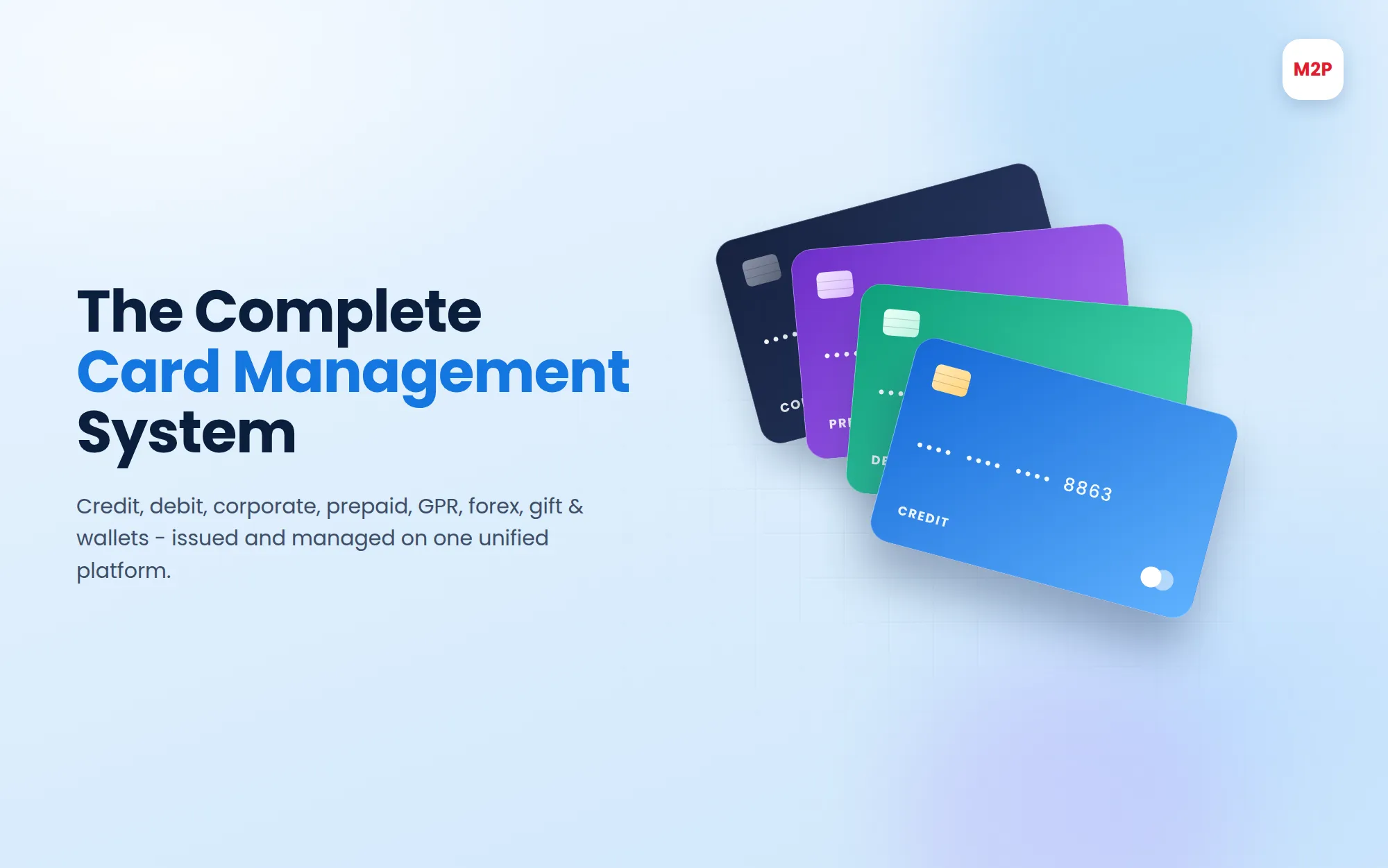
Every card a customer taps, swipes, or loads - credit, debit, prepaid, forex, or gift - is powered by a card management system (CMS) working quietly in the background. It's the software layer that decides whether a card gets issued, how it's controlled, what happens when it's lost, and how its entire lifecycle is tracked from the moment it's created to the moment it's closed.
According to The Business Research Company, the global credit card issuance services market is on track to grow from roughly $565 billion in 2025 to $860 billion by 2030 - a clear signal that banks, fintechs, and enterprises everywhere are racing to modernize how they issue and manage cards. But "card management system" isn't one single thing. It spans multiple distinct product lines - credit, debit, corporate / commercial cards, prepaid, GPR, forex, gift cards, and digital wallets - each with its own use cases, regulatory nuances, and buyer questions.
This guide breaks down what a card management system actually does, walks through each major product line it needs to support, and shows you what to look for in a platform that can handle all of it under one roof.
A card management system is the core infrastructure that lets banks, fintechs, NBFCs, and enterprises issue, configure, and manage the full lifecycle of physical and virtual payment cards. It sits between the card network (Visa, Mastercard, RuPay, etc.), the issuing bank, and the end customer, handling everything from card creation to activation, spend controls, freezing, replacement, and closure.
It's worth separating a CMS from a few adjacent terms people often use interchangeably:
Card processor - handles the real-time authorization and settlement of transactions. A CMS often sits on top of or alongside a processor.
Card issuing platform - frequently used as a synonym for CMS; technically refers to the layer that creates and provisions the card itself (BIN sponsorship, card creation, tokenization).
Program management - the broader operational function (compliance, reconciliation, customer support) that a CMS supports but doesn't fully replace on its own.
In practice, a modern card issuance platform bundles all of this - issuance, lifecycle management, and program operations - into a single API-driven stack, which is why the terms tend to blur together in the market.
Whether you're issuing credit, debit, or prepaid cards, a genuinely capable CMS needs to deliver:
Card issuance - instant virtual card issuance plus physical card fulfillment, with white-label design options
Lifecycle management - activation, PIN management, freeze/unfreeze, replacement, and closure, all API-driven
Controls and limits - velocity limits, MCC (merchant category code) restrictions, and geo-controls to manage risk and spend behavior
Compliance and security - PCI-DSS compliance, tokenization, and fraud/risk management built into the core stack rather than bolted on
API-first architecture - so the card program can be embedded directly into a bank's app, a fintech's product, or an enterprise's internal tools
Reconciliation and reporting - real-time dashboards and data-rich reporting so program managers aren't reconciling transactions manually
This is the foundation. What changes as you move across product lines — credit, debit, corporate, prepaid - is how these capabilities get configured and which regulatory and operational nuances come into play.
Credit card issuance is the most operationally complex of the card product lines, spanning credit card processing software, credit card lifecycle management, and credit card portfolio management - often across multiple partner banks and card networks simultaneously.
A modern credit card management system needs to handle origination (credit checks, limit assignment), ongoing lifecycle events (statement generation, billing cycles, repayments), and increasingly, cobranded credit card programs where a retailer, airline, or platform partners with a bank to launch a jointly branded card. M2P's own Credit Card Management System, for instance, has been used to power secured credit card programs where credit limits are automatically calculated against a customer's fixed deposit - read more in The Digital Blueprint for Secured Credit.
Newer capabilities are also reshaping how issuers think about the customer experience - M2P's Multi-Card, Single Account feature lets cardholders link multiple credit cards across networks into one unified account with a single consolidated statement, cutting down on the fragmentation that's traditionally plagued multi-card users.
Key use cases: consumer credit card programs, cobranded retail / travel / airline cards, secured credit programs, fintech-bank partnership issuance.
Corporate cards are their own category, driven by very different needs: spend visibility, policy enforcement, and integration with expense management - not just issuance. This is where terms like corporate spend management card, business credit card platform, and employee expense card solution come in.
A well-built corporate card issuance platform typically supports multiple billing models to fit how a business wants liability structured - centralized billing with automatic limit resets, individual billing with corporate oversight and partial repayments, or fully decentralized billing where employees are individually liable but the company retains visibility through aggregated reporting. M2P's Corporate Credit Card Stack, for example, supports all three models alongside MCC-based controls, multi-level approval workflows, and shared wallets where multiple cards draw from the same pool of funds - see the full breakdown in A Comprehensive Look at M2P's Corporate Credit Card Stack.
Key use cases: T&E (travel & expense) programs, departmental card issuance, vendor payment virtual cards, corporate incentive programs.
Debit card issuance is typically the highest-volume, most operationally sensitive card product a bank runs - which makes debit card lifecycle management and uptime non-negotiable. Core needs here include a reliable debit card API, fast debit card issuance software, and increasingly, virtual card issuance platform capabilities for instant digital-first debit cards.
Modernizing debit infrastructure is also one of the more common reasons banks migrate off legacy systems altogether. In one case, a small finance bank moved over 500,000 active debit card accounts to a modular, cloud-first debit card management system without disrupting day-to-day operations - full case study here: How a Leading Small Finance Bank Modernized Its Debit Card Infra with M2P.
Key use cases: neobank debit programs, payroll debit cards, core banking modernization, contactless/transit-linked debit issuance.
Prepaid is the broadest and most versatile card category - it covers everything from GPR cards (general purpose reloadable) to payroll cards, incentive cards, and white label prepaid cards issued under a business's own brand.
A prepaid card platform needs to support a wide range of program types under one infrastructure: general purpose reloadable, payroll, travel forex, teen / family cards, government disbursement, and corporate incentive programs - each with different KYC tiers and load / unload rules. This versatility is exactly why prepaid instruments are often described as the most flexible card category in fintech, spanning wallet creation, card issuance, and load/unload in a single stack.
Businesses evaluating a prepaid card issuance platform should also weigh multi-vendor complexity - stitching together separate vendors for KYC, card issuance, and reconciliation tends to slow programs down and increase operational overhead, which is a big part of why scaling prepaid programs on a single unified platform has become a priority for issuers. For more on avoiding that trap, see How to Scale Your Prepaid Card Program And Avoid the Multi-Vendor Trap.
Key use cases: GPR programs, payroll disbursement, incentive and rewards programs, unbanked/underbanked financial access, teen and family cards.
Forex cards serve a specific but fast-growing use case: multi-currency spend for travelers and cross-border payers. A good forex card platform allows a single card to hold multiple currencies - some platforms support two dozen or more - locking in exchange rates and eliminating the fluctuating markup fees typical of standard debit or credit card use abroad.
Beyond travel, cross border payments infrastructure increasingly overlaps with forex card issuance, since both require currency conversion, compliance screening, and international payout rails. Learn more about this category in Global Payments, Simplified: M2P's Turnkey Platform for Forex Cards.
Key use cases: international travel cards, remittance-linked forex cards, multi-currency corporate travel programs.
Gift cards are non-reloadable, prepaid-by-design instruments - usually issued by banks or retailers as a cash alternative for purchases at a specific store or network of merchants. A gift card management system needs to support both closed-loop (single merchant) and
open-loop (network-wide) programs, along with white label gift card platform capabilities so brands can issue cards under their own identity.
Key use cases: retail loyalty and gifting programs, corporate gifting, incentive and rewards disbursement.
Wallets and cards are increasingly issued together rather than separately. A digital wallet platform built as wallet as a service allows a business to combine wallet creation, fund load/unload, and card issuance - physical or virtual - into a single customer experience, often layered with UPI or card interoperability depending on the market.
Key use cases: super-app wallets, closed-loop merchant wallets, wallet-linked prepaid or debit card issuance.
Here's the pattern across every product line above: the underlying technical needs - issuance, lifecycle management, controls, compliance - repeat themselves, but most businesses end up managing them through separate vendors for credit, debit, prepaid, and wallets. That fragmentation creates real costs: multiple integrations to maintain, inconsistent controls across products, and slower time-to-market every time a new card program launches.
M2P's Card Management Stack is built to close that gap - a single, API-first infrastructure covering credit, debit, corporate cards, prepaid, GPR, forex, gift cards, and wallets, pre-integrated with fraud and risk management, KYC / KYB, reconciliation, and loyalty modules rather than requiring separate point solutions for each. That means a bank or fintech can launch a debit program today and extend into corporate cards or prepaid tomorrow without re-architecting their stack from scratch. It's the same infrastructure philosophy behind M2P's broader banking and payments suite - you can see how these pieces fit together across the wider platform in The Widest Infrastructure Stack in Banking & Fintech.
If you're evaluating a card issuance platform and want to see how the stack handles your specific product line - whether that's corporate cards, prepaid, or debit - our team can walk you through it. Talk to us today!
What is a card issuance platform?
A card issuance platform is the software infrastructure that creates and provisions payment cards - physical or virtual - and connects them to a card network and issuing bank. It's often used interchangeably with "card management system," though issuance is technically just one part of the full lifecycle a CMS manages.
What's the difference between a card management system and a card processor?
A card processor handles real-time transaction authorization and settlement. A card management system sits alongside or on top of the processor and manages the broader lifecycle - issuance, controls, activation, freezing, and closure.
What is a GPR (general purpose reloadable) card?
A GPR card is a reloadable prepaid card that functions similarly to a debit card but isn't tied to a traditional bank account. It's commonly used for payroll disbursement, government benefits, and general everyday spending.
How does a corporate card issuance lifecycle typically work?
It usually spans card issuance to employees or departments, policy-based spend controls (MCC restrictions, limits), a chosen billing model (centralized, individual, or hybrid liability), and ongoing reconciliation and reporting for finance teams.
Can one platform issue credit, debit, and prepaid cards?
Yes - modern card management platforms are increasingly built to support multiple product lines (credit, debit, prepaid, corporate, gift, forex) on a single unified stack rather than requiring separate vendors for each.
Fintech is evolving every day. That's why you need our newsletter! Get the latest fintech news, views, insights, directly to your inbox every fortnight for FREE!