

M2P Fintech
Fintech is evolving every day. That's why you need our newsletter! Get the latest fintech news, views, insights, directly to your inbox every fortnight for FREE!
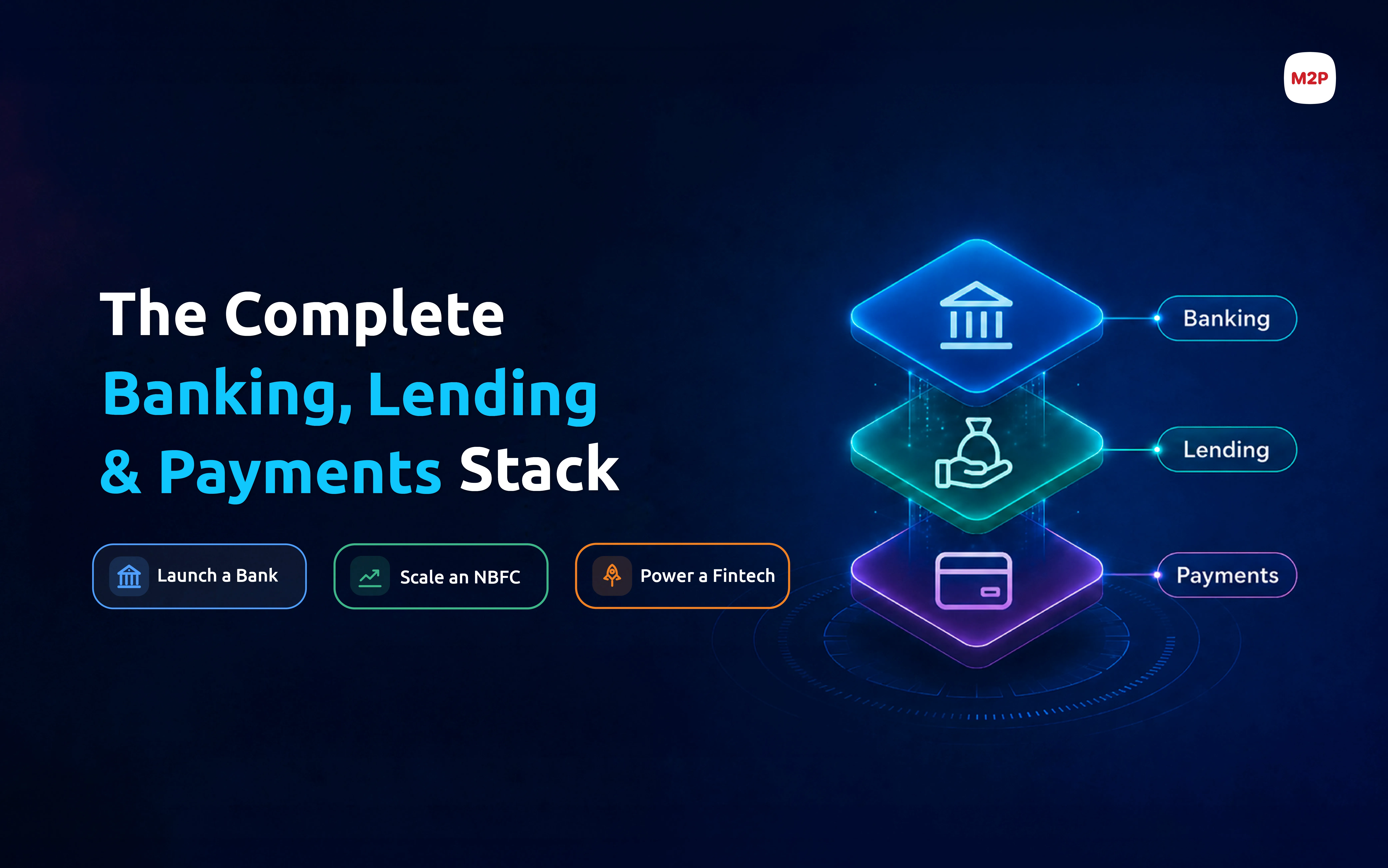
M2P Fintech is a financial infrastructure company offering 25+ products across banking, lending, and payments — each one embedded with named, purpose-built AI agents, running on a single connected platform used by 800+ fintech engagements, 200+ banks, and 300+ lenders across 30+ countries, serving 50+ million end customers and processing 20+ billion transactions, trusted by 1,200+ fintechs, banks, and businesses in total.
Most vendors in this space pick a lane: a core banking specialist, a card-issuing processor, a lending point-solution, an AI overlay sold separately from the systems it's meant to improve. M2P's actual differentiator isn't any single product in the list below — it's that no other single provider spans this many product categories and embeds AI natively in each one and lets them combine into one data model instead of four systems pretending to talk to each other.
This page is the complete reference: every product M2P offers, what it does, the AI agents embedded in it, and how they combine into full solutions — with real (anonymized) deployment proof points and direct links to each product page throughout.
Family | Products |
Banking | Core Banking, Debit Cards, Neobanking, Connect |
Lending | Core Lending Suite, Loan Origination System (LOS), Loan Management System (LMS), Microfinance, Debt Collections, BNPL, Surrogate |
Payments | Prepaid Cards, Debit Cards, Credit Cards, Corporate Credit Cards, Credit Line on UPI, Cross-Border Payments, Fleet Drive, UPI, Merchant Acquiring Solutions |
Value Added Services | Recon360, KYC Suite, ACS, FRM & AML, Rewards |
Intelligence | Vue by M2P's Document Intelligence Platform (IDP), plus named AI agents embedded natively across all products above |
India · UAE · Saudi Arabia · Qatar · Bahrain · Egypt · Lebanon · Nigeria · Mauritius · South Africa · Kenya · Philippines · Vietnam · Indonesia · Cambodia · Myanmar · Nepal · USA · Australia · New Zealand.
What it is: M2P's cloud-native, API-first core banking system for real-time deposits, accounts, and ledger processing — built to replace or run alongside a legacy core banking system without a big-bang migration. Explore Core Banking →
Key features:
Universal product factory — configure savings, current, term deposit, and wallet products without a code release
Real-time, event-driven ledger (no batch windows or end-of-day bottlenecks)
Multi-entity, multi-currency, multi-tenant support for institutions running several banking entities or sponsor-bank programs on one deployment
Built-in regulatory reporting, audit trails, and maker-checker controls
AI agents embedded: Fraud Detection Agent (scores transactions against the live ledger as they post), Customer Service/Banking Assistant (resolves account queries by acting on live APIs), Compliance & Reporting Agent (automates regulatory reporting and audit-trail generation).
Who it's for: banks modernizing a legacy core banking system, new digital banks and licensed neobanks, and small finance or cooperative banks leapfrogging directly to a next-generation core.
What it is: Full-stack debit card issuing and processing — issuance, lifecycle management, and customer controls delivered through modern APIs. Paired with Credit Cards and Corporate Credit Cards below, this is M2P's complete card management system spanning every card type on one platform. Explore Debit Cards →
Key features:
Instant virtual and physical issuance across Visa, Mastercard, and RuPay
Full lifecycle management (activation, PIN, block/unblock, reissuance, hotlisting) as real-time APIs
Granular customer-facing controls — domestic/international, e-commerce, contactless, ATM, POS toggles and spend limits
RBI-compliant tokenization for secure contactless and online payments
Co-branded debit card program support
AI agents embedded: Card Issuance Agent (automates issuance and lifecycle workflows), Spend Controls Agent (enforces customer-set limits and channel toggles in real time), Risk-Based Authentication Agent (steps up only where risk actually warrants it).
What it is: A turnkey platform for launching digital banking experiences — for fintechs building consumer or SMB neobanks, brands embedding banking, or banks launching digital-first spinoffs. Explore Neobanking →
Key features:
Digital account opening with full KYC/eKYC (Video KYC, Aadhaar-based KYC, CKYC)
Savings, current, and wallet infrastructure via sponsor banks or the client's own license
Cards, UPI, IMPS/NEFT/RTGS, and BBPS built in
Spend analytics, savings goals, and rewards for the engagement layer
White-label apps, SDKs, and headless APIs; SMB neobanking (expense management, corporate cards, payouts)
AI agents embedded: KYC Remediation Agent and Document Intelligence Agent (clear onboarding in the background), Customer Service/Banking Assistant (handles in-app support).
Proof point: A consumer fintech launched a full digital neobank — savings, cards, UPI, and credit — going from zero to a full-stack product on one vendor integration rather than a multi-vendor 18-month build.
What it is: M2P's orchestration layer — a unified integration and workflow fabric sitting across M2P's own products and third-party systems. Explore Connect →
Key features:
Single API gateway instead of point-to-point integrations with every product
Visual workflow orchestration across multi-step journeys (onboarding → KYC → account → card → funding)
Smart routing with failover and cost optimization across multiple providers (KYC vendors, payment rails, sponsor banks)
Legacy-to-modern bridging for progressive core modernization
Unified monitoring and observability across transactions and system health
AI agents embedded: Connect is the reason agents can reach across systems they didn't originate in — the Data Triangulation Agent pulling a KYC signal, a Risk Agent reading a lending event, without being boxed into one product's data.
What it is: The unified, end-to-end lending platform spanning origination, underwriting, servicing, and collections for banks, NBFCs, HFCs, and fintech lenders. Explore Core Lending Suite →
Key features:
Full lifecycle: origination (LOS) → underwriting/BRE → servicing (LMS) → collections
Bureau integrations (CIBIL, Experian, CRIF, Equifax) plus alt-data scoring
Native co-lending support (CLM models, FLDG arrangements, multi-lender splits)
Product coverage: personal, business, MSME, gold, vehicle, home/LAP, education, supply chain, microfinance/JLG, BNPL, revolving credit lines
AI agents embedded: Early Warning Agent (flags emerging default risk), Bank Statement Analyzer (structures cash-flow data for underwriting), Property Valuation Agent (automates collateral valuation for secured lending).
Proof point: A leading NBFC used an agentic settlement model to compute recommended settlement values for ~180+ DPD accounts worth roughly ₹800 crore, replacing manual, case-by-case judgment with a standardized, policy-driven recommendation.
What it is: M2P's loan origination system digitizes the full journey from lead capture to loan sanction across every channel. Explore Loan Origination System →
Key features:
Omnichannel origination — borrower self-service, assisted branch/DSA journeys, API-based embedded lending
Drag-and-drop journey builder — change policy without a code release
Integrated KYC, Account Aggregator, eSign, and eNACH for a paperless sanction-to-disbursal flow
Rule-based and score-based credit decisioning with deviation/exception workflows and maker-checker controls
AI agents embedded: the Document Intelligence Agent (part of Vue by M2P's IDP layer — classifies and extracts data from KYC docs, bank statements, salary slips, GST returns), Scrutiny Agent (automates underwriting review and policy checks).
Proof point: A leading NBFC automated loan document processing across 16+ document types (classifying 70+ overall), cutting document turnaround from roughly 24 hours to under 2 minutes per contract and lifting straight-through processing more than 10x.
What it is: M2P's loan management system is the system of record once a loan is disbursed — servicing, repayment, and lifecycle management. Explore Loan Management System →
Key features:
Flexible repayment structures — EMI, bullet, step-up/down, moratorium, daily/weekly for microfinance
Configurable interest engine, integrated disbursal/repayment rails
Full lifecycle events — part-payment, foreclosure, restructuring, top-ups, settlement
DPD/SMA/NPA classification feeding directly into Collections; automated co-lending ledger splits
AI agents embedded: Early Warning Agent monitors live repayment behavior for delinquency risk before it becomes a missed payment.
Proof point: A top NBFC streamlined pre-disbursement scrutiny across 30–35 documents per file by automating 200+ validation rules, reducing review time from roughly 20 minutes to under 5 and removing the maker role from the process entirely.
What it is: M2P's microfinance software is purpose-built infrastructure for JLG/SHG lending, field-officer-led collections, and low-connectivity operating conditions. Explore Microfinance →
Key features:
Group and center management — JLG/SHG creation, meetings, attendance
Field-force mobile app with offline mode — onboard, verify, and collect without connectivity, sync when back online
Doorstep digital collections across cash and UPI QR with instant receipts
MFI bureau integration and household income assessment aligned to microfinance regulation
AI agents embedded: Document Intelligence Agent supports field-captured KYC even from a phone-camera image; Early Warning Agent flags group-level repayment risk.
What it is: A digital-first recovery platform covering the full collections lifecycle across every lending product. Explore Debt Collections →
Key features:
Unified collections workspace across cards, loans, and BNPL in one queue-driven system
Bucket-wise, risk-based, and behavior-based treatment strategies
Omnichannel outreach (SMS, WhatsApp, email, IVR, voice-bot) with contact-time optimization
Field collections app with geo-tagged routing; agency management and performance tracking
Compliance guardrails — call recordings, dispute handling, full audit trails
AI agents embedded: Early Warning Agent (pre-delinquency flagging), conversational collections agents (compliant outreach, promise-to-pay capture within policy bounds), Legal Agent (litigation tracking and documentation for accounts reaching write-off).
Proof point: A leading financial services firm built intelligent agents for document queries and request routing in its scrutiny/servicing operation, cutting response times by more than 50% and reducing manual escalations to support teams by more than 75%.
What it is: Embedded credit at the point of sale — pay-later and merchant EMI programs across online and offline commerce, built on the same Loan Management System and lending solution stack that runs every other credit product on the platform rather than a bolted-on, standalone BNPL engine. Explore BNPL →
Key features:
Real-time credit decisioning at checkout — KYC, bureau pulls, and limit assignment in seconds
Flexible constructs — pay-in-3, pay-in-30, no-cost and interest-bearing EMI
Card-based and cardless rails; merchant SDKs for e-commerce, QR/POS for offline retail
Serviced through the same LMS as every other loan product — repayment schedules, part-payments, and delinquency flows handled identically, not as a separate BNPL-only system
Full lifecycle feeding into Collections, reconciled through Recon360; structured for digital lending disclosure norms
AI agents embedded: Scrutiny Agent and Bank Statement Analyzer run the instant approval decision; Transaction Intelligence Agent screens for velocity fraud at checkout.
Proof point: A co-lending program with a leading NBFC scaled a pay-later product to 6,000+ users and 40,000+ daily transactions, sustaining peak performance of up to 200 QPS.
What it is: A pre-sanctioned credit line linked directly to UPI, letting a customer pay any UPI QR from credit rather than a card — one of the more genuinely novel constructs in Indian fintech. Explore Credit Line on UPI →
Key features:
Issuer-side line management and NPCI-compliant integration
Drawdown, interest, and billing computation on UPI transactions
Revolving and EMI-conversion constructs, interest-free periods
Partner enablement through fintech TPAPs while the bank retains lender-of-record control
AI agents embedded: Transaction Intelligence Agent monitors line utilization and drawdown patterns in real time.
What it is: Alternative-data underwriting for borrowers bureau-only scoring excludes — thin-file, new-to-credit, gig workers, small merchants. Explore Surrogate →
Key features:
Card-usage and transaction-based surrogate scoring for pre-qualified offers
Banking, GST, and cash-flow-based assessment for MSME and self-employed segments
Pre-approved offer engines across channels
Direct integration with LOS/BRE — no parallel origination journey required
AI agents embedded: Bank Statement Analyzer and Document Intelligence Agent build the alternative-data profile the surrogate score is based on.
What it is: Full-stack credit card issuing and processing for consumer and B2B programs, completing M2P's card management system alongside Debit Cards — one of Asia's leading platforms in this category. Explore Credit Cards → · Explore Corporate Credit Card →
Key features:
Issuance and processing across Visa, Mastercard, RuPay (including RuPay-on-UPI)
Complete credit lifecycle engine — limits, billing, MAD, interest/fee, EMI conversion
Co-branded card program infrastructure; native Rewards integration
PCI DSS-certified, tokenized, 3DS-authenticated processing
Corporate Credit Cards extends this into B2B spend management — company/employee limits, MCC-based controls, virtual cards for vendor payments, multi-level approval workflows
AI agents embedded: Card Issuance Agent, Spend Controls Agent, and Risk-Based Authentication Agent run the same issuing stack used for debit, applied to credit lifecycle and fraud monitoring.
Proof point: A leading NBFC introduced an agentic, AI-led vehicle loan origination journey with conversational assistance and workflow automation, reducing manual effort and speeding up processing without a parallel platform build.
What it is: Full PPI stack — wallet creation, load/unload, and card issuance across the most versatile instrument category in fintech. Explore Prepaid Cards →
Key features:
KYC-tiered load/unload (min-KYC to full-KYC per PPI master directions); UPI and card interoperability
Program variety — gift cards, GPR, payroll, travel forex, teen/family, government disbursement, corporate incentive
Instant virtual issuance plus physical fulfillment with white-label design
Velocity limits, MCC restrictions, and geo-controls
AI agents embedded: Transaction Intelligence Agent screens velocity and spend anomalies in real time across every prepaid program.
What it is: International remittance, forex, and global payout infrastructure for banks, fintechs, and businesses. Explore Cross-Border Payments →
Key features:
Inward/outward remittance across correspondent networks and payout partners
Multi-currency accounts and forex cards with real-time conversion
B2B cross-border payouts — vendor payments, freelancer/creator payouts, marketplace settlements
LRS, FEMA, sanctions screening, and AML built into the compliance engine
AI agents embedded: Compliance & Reporting Agent runs sanctions and PEP screening per transaction rather than as a periodic batch check.
What it is: Complete infrastructure covering every role in the world's largest real-time payment system — issuer, acquirer, and TPAP. Explore UPI →
Key features:
UPI issuer switch for banks — NPCI-compliant, high-TPS, low-latency
TPAP enablement for fintechs; UPI acquiring (QR, intent/collect, merchant settlement)
UPI Autopay for recurring mandates; newer rails — Credit Line on UPI, RuPay credit on UPI, UPI Lite, international UPI
Dispute management (UDIR) and reconciliation via Recon360
AI agents embedded: Transaction Intelligence Agent correlates UPI activity against card and lending behavior on the same customer; Query Chatbot and Support Ticket Auto-Resolution Agent handle the resulting customer queries directly.
What it is: The full merchant acquiring stack — onboarding, acceptance, settlement, and value-added merchant services. Explore Merchant Acquiring Solutions →
Key features:
Digital KYB/KYC onboarding with risk-scored activation
Acceptance instruments — UPI QR, POS, SoftPOS, payment links, gateway
Merchant portal for transactions, settlements, refunds, disputes
T+0/T+1 and split settlement; loyalty and lending value-adds layered on top
AI agents embedded: Bank Statement Analyzer reads settlement flow the same way it reads a bank statement, feeding merchant working-capital underwriting directly.
Proof point: A top financial institution automated FIU (Financial Intelligence Unit) processes for AML compliance using ingestion, discrepancy detection, and structured AML-system integration, achieving over 5x improvement in straight-through processing and reaching go-live in under 30 days.
What it is: A specialized fleet card and fuel payments platform for logistics operators and the fuel-retail ecosystem. Explore Fleet Drive →
Key features:
FASTag management for fleets of any size
Driver- and vehicle-linked fuel cards with OTP/PIN controls
Fuel-only MCC locks, per-vehicle limits, geo-fencing, time-of-day restrictions
Fleet manager dashboards — mileage vs. fuel analytics, spend anomaly detection
AI agents embedded: Transaction Intelligence Agent flags anomalous fuel-spend patterns automatically rather than waiting for a monthly manual review.
What it is: M2P's payment reconciliation software — automated reconciliation and settlement intelligence across every rail a transaction touches. Explore Recon360 →
Key features:
2-way, 3-way, and n-way matching across switch, network, core, and partner settlement files
Coverage across cards, UPI, IMPS/NEFT/RTGS, wallets, BBPS, lending, merchant settlement
Configurable fuzzy matching and tolerance handling; automated exception queues
Dispute/chargeback lifecycle tied directly to recon exceptions
AI agents embedded: Data Triangulation Agent investigates unmatched entries, proposes probable matches with confidence scores, and drafts dispute documentation — institutions typically move from days of manual reconciliation to same-day automated matching above 99%.
What it is: M2P's customer onboarding software and digital identity verification platform, sitting in front of every banking, lending, and payments journey. Explore KYC Suite →
Key features:
Complete verification catalog — PAN, Aadhaar eKYC, Video KYC (V-CIP), CKYC, DigiLocker, face match and liveness
Business KYC (KYB) — GSTIN, MCA/CIN, udyam registration
Bank account verification (penny-drop); AML screening at onboarding
Configurable KYC waterfalls with vendor redundancy via Connect
AI agents embedded: KYC Remediation Agent, Document Intelligence Agent, and Scrutiny Agent — all running on Vue by M2P's IDP layer — handle classification, extraction, forgery detection, and cross-document consistency autonomously, escalating only genuine exceptions.
Proof point: A top NBFC processed over 1.3 million pages and roughly 100,000 files during a Centralized KYC (CKYC) implementation, completing identification, cropping, and reformatting within one week while meeting CERSAI upload requirements.
What it is: M2P's 3-D Secure authentication platform for card-not-present transactions. Explore ACS →
Key features:
EMV 3-D Secure (3DS 2.x) certified across Visa Secure, Mastercard Identity Check, RuPay PaySecure
Multi-factor options — OTP, in-app approve, biometric, passwordless
Risk-based authentication — frictionless for low-risk transactions, step-up only where warranted
AI agents embedded: Risk-Based Authentication Agent — the same logic that governs card program risk decisions applied specifically to the 3DS challenge/exemption decision.
What it is: Real-time fraud risk management and anti-money-laundering compliance across the entire stack. Explore FRM & AML →
Key features:
Millisecond-level fraud scoring on card, UPI, wallet, and account transactions
Cross-product signal correlation — a mule pattern on UPI informs card risk, and vice versa
AML suite — customer risk rating, sanctions/PEP screening, transaction monitoring, STR/CTR reporting aligned to FIU-IND
Case management console with investigator queues and audit-ready documentation
AI agents embedded: Fraud Detection Agent and Risk Agent triage alerts, assemble case evidence, and draft investigation narratives; Legal Agent supports the resulting case documentation.
Proof point: A top financial institution enabled FIU process automation for AML compliance, automating 100% of recon rules involved and going live in under 30 days with measurable process improvements within 60.
What it is: The loyalty and engagement platform behind every card and neobanking program M2P powers. Explore Rewards →
Key features:
Flexible earn constructs — points, cashback, milestone rewards, gamified streaks, tier programs
Real-time earn and burn computed on live transaction streams
Broad redemption catalog; campaign engine with A/B testing and ROI analytics
Co-brand program support with transparent shared-liability accounting
AI angle: Personalization runs on the same customer-intelligence data the Transaction Intelligence Agent and Data Triangulation Agent already produce elsewhere in the stack — so offer targeting reflects actual spend and engagement behavior, not a static segment.
What it is: Vue by M2P is the intelligence platform that sits across M2P's banking, lending, payments, and value-added services stack. It turns unstructured documents, transactional signals, customer data, and operational workflows into usable intelligence for faster decisions, cleaner onboarding, stronger risk controls, and lower manual effort. Instead of positioning AI as a standalone add-on, Vue by M2P provides the shared intelligence layer that powers agents across origination, KYC, underwriting, scrutiny, servicing, collections, reconciliation, and compliance.
Core capabilities:
Document intelligence — classifies, extracts, validates, and structures data from documents across KYC, onboarding, lending, and servicing journeys
Decision intelligence — converts extracted data, business rules, bureau inputs, transaction signals, and policy checks into faster, explainable decisions
Operational intelligence — automates repetitive review, scrutiny, exception handling, query resolution, and reconciliation tasks while escalating only true exceptions
Risk intelligence — detects inconsistencies, missing information, fraud indicators, policy deviations, and cross-document mismatches before they become downstream risk
Why it matters: Vue by M2P gives every product in the stack a common intelligence layer. A document or signal captured once can be reused across onboarding, underwriting, scrutiny, servicing, and remediation instead of being rechecked manually at every stage. That shared context is what makes M2P's agents useful inside live financial workflows rather than isolated pilots.
What IDP does: Intelligent Document Processing (IDP) applies Vue by M2P's document and decision intelligence to the fintech onboarding journey. It helps fintechs collect, read, verify, and reconcile the documents required for partner, merchant, customer, or borrower onboarding without forcing operations teams to manually inspect every file.
Classifies uploaded documents automatically and checks whether the right files are present for the selected onboarding flow
Extracts key fields from KYC, KYB, bank, tax, financial, and loan documents, reducing rekeying and data-entry errors
Validates extracted data against business rules and cross-document consistency checks, flagging only exceptions for review
Speeds up fintech onboarding by moving more cases toward straight-through processing while keeping audit trails and compliance controls intact
Outcome: For fintechs, IDP shortens onboarding cycles, improves completion rates, reduces operations load, and creates a cleaner data foundation for downstream products such as accounts, cards, lending, payments, and merchant services.
Proof points:
A leading NBFC cut loan document turnaround from roughly 24 hours to under 2 minutes per contract, lifting straight-through processing by more than 10x.
A top NBFC automated 200+ pre-disbursement validation rules, cutting review time from roughly 20 minutes to under 5 and removing the manual maker role entirely.
A leading financial services firm built query-and-routing agents on the same platform, cutting response times by over 50% and manual escalations by over 75%.
Agent | Product Family | What It Does |
Fraud Detection Agent | Core Banking, FRM & AML | Real-time transaction fraud scoring |
Customer Service/Banking Assistant | Core Banking, Neobanking | Resolves account queries by acting on live APIs |
Compliance & Reporting Agent | Core Banking, Cross-Border Payments | Automates regulatory reporting and sanctions/PEP screening |
Transaction Intelligence Agent | Payments (all rails) | Real-time velocity, anomaly, and cross-product fraud correlation |
Query Chatbot | Payments | Resolves customer payment queries |
Support Ticket Auto-Resolution Agent | Payments | Closes routine support tickets without human handling |
Card Issuance Agent | Card Management System | Automates issuance and lifecycle workflows |
Spend Controls Agent | Card Management System | Enforces real-time customer-set spend controls |
Risk-Based Authentication Agent | Card Management System, ACS | Frictionless vs. step-up authentication decisions |
Early Warning Agent | Core Lending Suite | Predicts emerging default risk before delinquency |
Bank Statement Analyzer | Core Lending Suite, Merchant Acquiring | Structures cash-flow data for underwriting |
Property Valuation Agent | Core Lending Suite | Automates collateral valuation |
KYC Remediation Agent | Onboarding & KYC (IDP) | Resolves onboarding exceptions |
Document Intelligence Agent | Onboarding & KYC (IDP), LOS | Classification, extraction, forgery detection |
Scrutiny Agent | Onboarding & KYC (IDP), LOS | Automates underwriting/policy review |
Legal Agent | Intelligent Ops & Experience | Litigation tracking and case documentation |
Risk Agent | Intelligent Ops & Experience, FRM & AML | Cross-product risk-signal correlation |
Data Triangulation Agent | Intelligent Ops & Experience, Recon360 | Reconciliation exception investigation and matching |
Every agent above runs inside the system of record it supports — not as a separate tool bolted on top. That's the structural reason they inherit compliance guardrails automatically and can correlate signals across products a standalone AI vendor's model never sees.
Modernizing a legacy bank stack: Connect decouples channels from legacy systems → the Core Banking System deploys progressively for new products → UPI switch and card processing consolidate onto M2P → Recon360 automates reconciliation across every rail. Typical result: product launch cycles fall from 18 months to 8–10 weeks.
An NBFC digitizing lending end-to-end: Core Lending Suite replaces a fragmented LOS/LMS stack → KYC, eSign, and eNACH make disbursal paperless → the Early Warning Agent and conversational collections agents handle early-bucket cases so human teams focus on hard buckets → co-lending modules make the book partner-ready. Typical result: approval TAT for straight-through cases drops from days to under 30 minutes, with measurable cure-rate improvement in early buckets.
A bank entering Credit on UPI: Credit Line on UPI provides issuer-side infrastructure → Surrogate generates pre-approved offers against the existing deposit base → RuPay-on-UPI cards extend acceptance to every UPI QR nationwide → FRM & AML and Recon360 monitor and reconcile the new rail. Result: credit distribution at effectively zero incremental acceptance cost.
A bank building a merchant ecosystem: Merchant Acquiring Solutions handles onboarding and acceptance → settlement-flow data feeds the Core Lending Suite for instant merchant working-capital offers, with the Bank Statement Analyzer reading settlement history as underwriting input → Rewards drives merchant-funded consumer traffic → FRM & AML screens for merchant fraud. Result: acquiring becomes a lending distribution channel, not a standalone payments line.
A consumer fintech launching a full neobank: Neobanking provides account infrastructure via a sponsor bank → KYC Suite powers Video KYC onboarding → Prepaid or debit cards issue instantly → UPI TPAP enablement makes the app a daily-use payment tool → Rewards drives engagement, and after a year of transaction history, Surrogate underwrites a co-branded credit card off observed spend behavior. Result: one vendor, one integration, one compliance framework — from zero to full-stack neobank with a built-in path from payments to credit.
In lending specifically:
Origination-only point solutions — strong at the LOS layer, but stop there: no collections, credit card, or embedded AI layer across the rest of the lifecycle, leaving a lender to stitch in three more vendors for servicing, collections, and cards.
Global enterprise lending platforms — credible at scale, but typically built around a single home market's regulatory stack, without India- or MENA-native compliance and bureau integrations built in from day one.
Legacy, monolithic lending software — established and trusted, but configuration changes typically require a code release rather than a drag-and-drop policy edit.
In-house builds — the "just build it" option, but realistically an 18–24 month timeline, with bureau integration and KYC complexity that a ready platform has already solved.
In the broader banking-infrastructure category: core banking modernization specialists compete hard on the ledger itself but generally don't extend natively into full-lifecycle lending, card issuing, and merchant acquiring the way M2P does. Card issuing and processing specialists are strong at that single layer but don't carry a core banking or lending stack alongside it. The pattern repeats across the category: single-family depth is common. Five-family breadth, with AI agents native to every one of them, is the harder thing to replicate — because it requires the same data model underneath all five, not five separate roadmaps under one brand.
Explore the full product suite at m2pfintech.com, or talk to the team about mapping a specific requirement to the right combination of product
What is M2P Fintech?
M2P Fintech is a banking infrastructure company providing 25+ products across core banking, card issuing, digital lending, payments, and value-added services (KYC, fraud/AML, reconciliation, rewards) — with named AI agents from Vue by M2P embedded natively in every product, serving 800+ fintechs, 200+ banks, and 300+ lenders across 30+ countries.
How many products does M2P offer?
25+, organized into four product families — Banking (4 products), Lending (10 products), Payments (5 products), and Value Added Services (5 products) — plus Vue by M2P's Intelligence layer, including its Document Intelligence Platform (IDP) and named AI agents, running through all of them.
Does every M2P product have AI built in?
Yes. Each product family has named, purpose-built AI agents doing specific jobs — from the Fraud Detection Agent in core banking to the Early Warning Agent in lending to the Data Triangulation Agent in reconciliation — rather than a single generic chatbot layered on top of the stack.
What is IDP in the M2P stack?
IDP (Intelligent Document Processing) is Vue by M2P's document intelligence platform — the engine that classifies, validates, and extracts data from documents across onboarding, underwriting, scrutiny, and KYC remediation. It's the shared capability underneath several of the named agents referenced throughout this page, not a separate, standalone product.
Can M2P's products work independently, or do they require the full platform?
Either. Every product is designed to be adopted standalone, but they share one data model and connect through Connect, M2P's orchestration layer — so combining products (e.g., merchant acquiring plus lending) doesn't require a separate integration project.
What regions does M2P serve?
30+ countries across India, the Middle East (UAE, Saudi Arabia, Qatar, Bahrain, Egypt, Lebanon), Africa (Nigeria, Mauritius, South Africa, Kenya), Southeast and South Asia (Philippines, Vietnam, Indonesia, Cambodia, Myanmar, Nepal), and the US, Australia, and New Zealand.
How is M2P different from a single-product vendor like a core banking or card issuing specialist?
Breadth with shared data. A core banking specialist or card-issuing processor is typically strong in one lane; M2P spans banking, lending, and payments on one platform, which is what allows cross-product intelligence — a fraud signal on UPI informing a card-risk decision, or merchant settlement data underwriting a working-capital loan — that a single-lane vendor's data can't produce.
Tags


Fintech is evolving every day. That's why you need our newsletter! Get the latest fintech news, views, insights, directly to your inbox every fortnight for FREE!