

M2P Fintech
Fintech is evolving every day. That's why you need our newsletter! Get the latest fintech news, views, insights, directly to your inbox every fortnight for FREE!
Most banks that launch a credit line on UPI design the lending side in detail and the payments side last. Then the first month-end arrives. The switch shows one number, the credit ledger another, and the NPCI settlement file a third.
Credit line on UPI reconciliation and fraud controls answer one question for every payment. Did the right line pay the right amount, for a permitted purpose, and did it settle? This guide takes risk and operations teams through seven steps, from the dedicated UPI PIN to a daily three-way match.
It is written for heads of unsecured lending, fraud risk managers, and payment operations leads at Indian banks. Their banks issue, or plan to issue, pre-sanctioned credit lines on the Unified Payments Interface (UPI). If you are new to the product, start with how a credit line on UPI works.
By the end, you will have a control map for fraud, a matching design for reconciliation, and a checklist to test your setup against.
UPI was built for bank accounts. A credit line changes three things: the product rules, the issuer's duties, and the books.
Read what a credit line on UPI means for banks.
The product rules. The National Payments Corporation of India (NPCI) issued a UPI Consolidated Circular on September 18, 2026. It splits credit on UPI into interest-free credit lines (CLIF) and interest-bearing credit lines (CLIB). Only CLIB lines can make person-to-person (P2P) payments. Both can be used for merchant payments, EMIs, UPI AutoPay, and UPI Reserve Pay.
The issuer's duties. Under the same circular, the issuer approves or declines each UPI transaction against the credit's defined purpose and its board-approved policy. Restricted categories stay blocked, and credit accounts cannot be used for UPI cash withdrawal at business correspondent points.
The books. A savings account debit on UPI lands in the core banking ledger. A credit line debit passes through the bank's UPI switch into a revolving credit ledger that tracks the limit, interest, and dues. That ledger often sits in a separate system, which is why credit line on UPI reconciliation needs its own design.
Put these four things in place before you build controls.
NPCI's credit line on UPI product page asks users to set a distinct UPI PIN for the credit line and not to reuse their savings account PIN. The consolidated circular goes further. Device binding and PIN setting at onboarding count as the customer's consent to use the line for all UPI transaction types.
So the PIN-set event is the moment a sanction becomes spendable money. Score it like a transaction. Flag PIN setup on a newly bound device, soon after a SIM or mobile number change, or within minutes of the sanction itself.
When a line is linked, confirm it on a channel outside the UPI app. The customer can then stop a linking they did not start. The pitfall is leaving linking to the app team as a user experience step. A line linked by a fraudster is a funded account with no deposit behind it.
The issuer decides on every request, and the circular gives the remitter bank 15 seconds to respond to a pay request. That window has to hold the credit check, the purpose check, and the fraud score.
A credit line on UPI fraud check at authorization should read at least five signals.
1- Purpose and MCC. Does the payee's MCC sit on the product's permitted list? Is a CLIF line attempting a P2P payment?
2- Payee risk. Is the payee a new UPI ID, a small merchant, or a merchant other lines have flagged?
3- Device and session. How old is the device binding, and does the device show rooting or emulator signals?
4- Velocity. How do the count and value of payments in the last hour compare with this customer's own history?
5- Mule signals. Does the payee appear on shared lists such as the Mobile Number Revocation List or the Digital Intelligence Platform that the circular asks members to use?
Run the credit decision and the fraud score in parallel, not one after the other. Two sequential calls eat the response window and push teams to loosen rules to avoid timeouts. For a wider view of UPI fraud typologies, see our guide to UPI fraud and NPCI's safeguards.
On a credit card, utilization is often reviewed at statement time. On UPI, a limit can be drawn down in an afternoon through many small QR payments, so utilization is your earliest warning.
Track four patterns for every line.
Speed to full draw. Lines that go from linked to nearly fully drawn in days need a review before the next limit change.
Shape of spend. Many low-value payments to unrelated small merchants differ from the customer's usual pattern.
Repay-and-redraw loops. A repayment credited and redrawn the same day, again and again, can signal cycling.
Failed repayment, then spend. A bounced AutoPay repayment followed by fresh draws is a strong signal.
The Reserve Bank of India (RBI) issued its Master Directions on Fraud Risk Management on July 15, 2024. They require banks to run a framework for Early Warning Signals (EWS) and Red Flagging of Accounts (RFA). Utilization patterns are natural EWS inputs for a revolving line, so feed them into that framework rather than a separate dashboard.
Stolen phones and social engineering get most of the attention. Revolving lines also attract first-party fraud, where the real customer borrows with no intent to repay.
Five patterns come up most often.
Bust-out. The customer builds a clean record, wins a limit increase, then draws the full line in a burst and stops paying.
Cash-out through colluding merchants. Payments go to a small merchant's QR code that hands back cash. Small-merchant payments settle to the merchant in real time, so the money leaves fast.
P2P drain on CLIB lines. The line is emptied through transfers to the customer's own or friendly accounts.
Borrowed or synthetic identity. The line is sanctioned to an identity the real person does not control.
Friendly disputes. The customer disputes genuine merchant payments to reverse spend.
The controls that work are practical. Run link analysis across payees, share merchant-level monitoring with acquirers, and hold limit increases until repayments come from an external account. Cases that meet your thresholds should flow into the RFA process, with a full audit trail. Strong fraud and risk management here also supports anti-money laundering (AML) monitoring, because credit drawn and moved on quickly is a layering risk.
This is where credit line on UPI reconciliation departs from bank-account UPI. NPCI requires every member to reconcile UPI transactions daily and to use automated systems to do it. For a credit line, the credit ledger takes the place of the account ledger in the match.
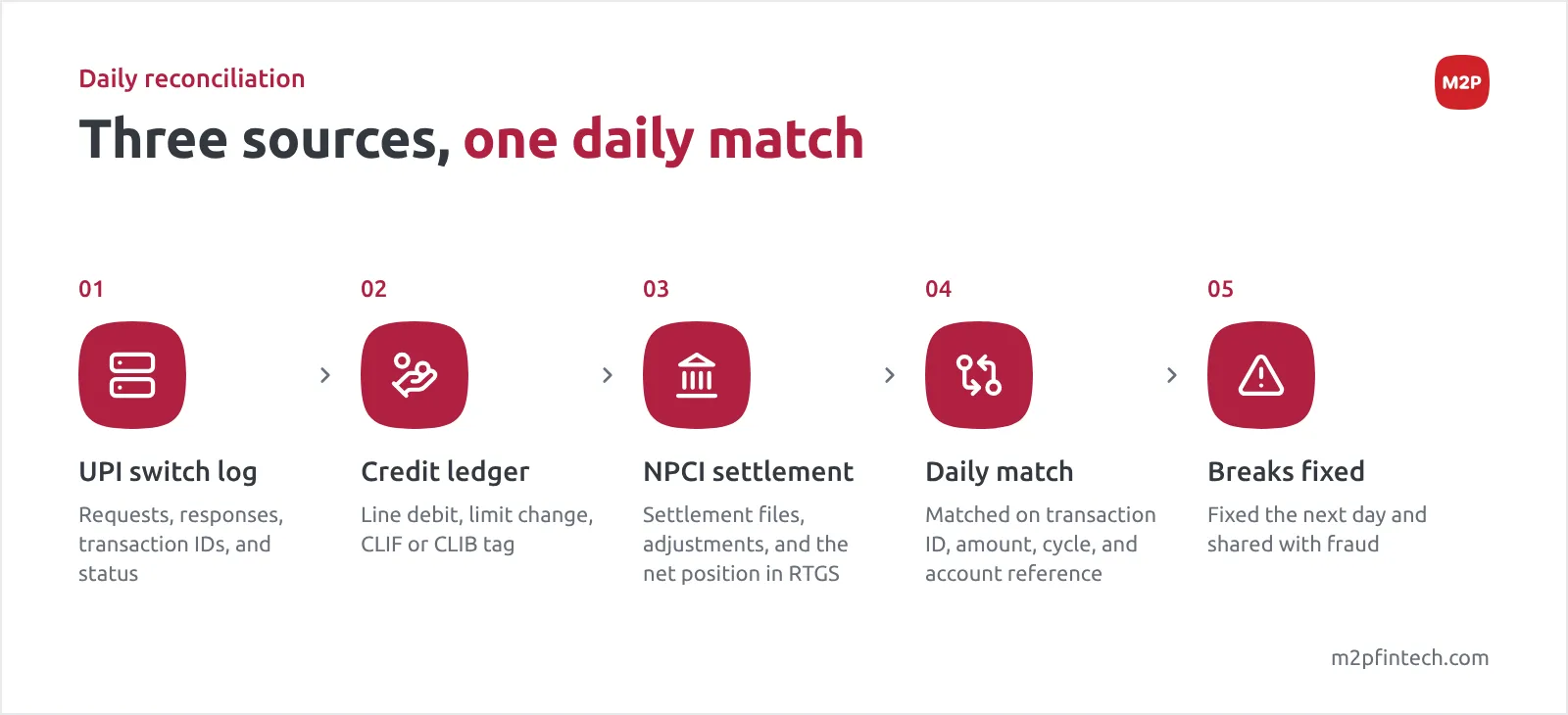
1- The UPI switch log. Every request and response, with transaction ID, reference number, amount, status, and the account reference.
2- The credit ledger. The debit to the line, the change in available limit, the CLIF or CLIB tag, fees, and repayment credits.
3- NPCI settlement. Settlement files, adjustment reports, and the net position posted through the multilateral net settlement batch in RTGS.
Match on transaction ID, reference number, amount, and settlement cycle. NPCI has asked members to standardize the account sub type and account reference number for credit on UPI by December 15, 2026. Build that reference into your matching rules now, so line-level matching does not depend on free-text fields.
Every break type tells you something different.
In the switch and settlement, missing in the ledger. The customer received credit the line never recorded, so the bank carries an unbooked exposure.
In the ledger, missing in settlement. The line was debited for a payment that did not settle, so the customer is owed a reversal.
Amount mismatch or duplicate. Usually a retry or partial reversal posted twice.
Repayments are part of credit line on UPI reconciliation too, in reverse. An inward UPI credit to the line's repayment ID must reduce the outstanding balance on the ledger and appear in settlement. For background on how a request moves through the UPI stack, read how the NPCI mapper, switch, and PSP work together.
Most breaks in credit line on UPI reconciliation come from a few states. These are timed-out, deemed approved, declined after debit, reversed, and refunded. NPCI's rules set how to chase each one.
Payer PSPs can send up to three check transaction status calls, starting at least 60 seconds after the original request. Members live on the Unified Dispute and Issue Resolution (UDIR) system must not post manual credits or reversals on the transaction date. They post them the next day, after checking the latest settlement and adjustment reports, to avoid double reversals.
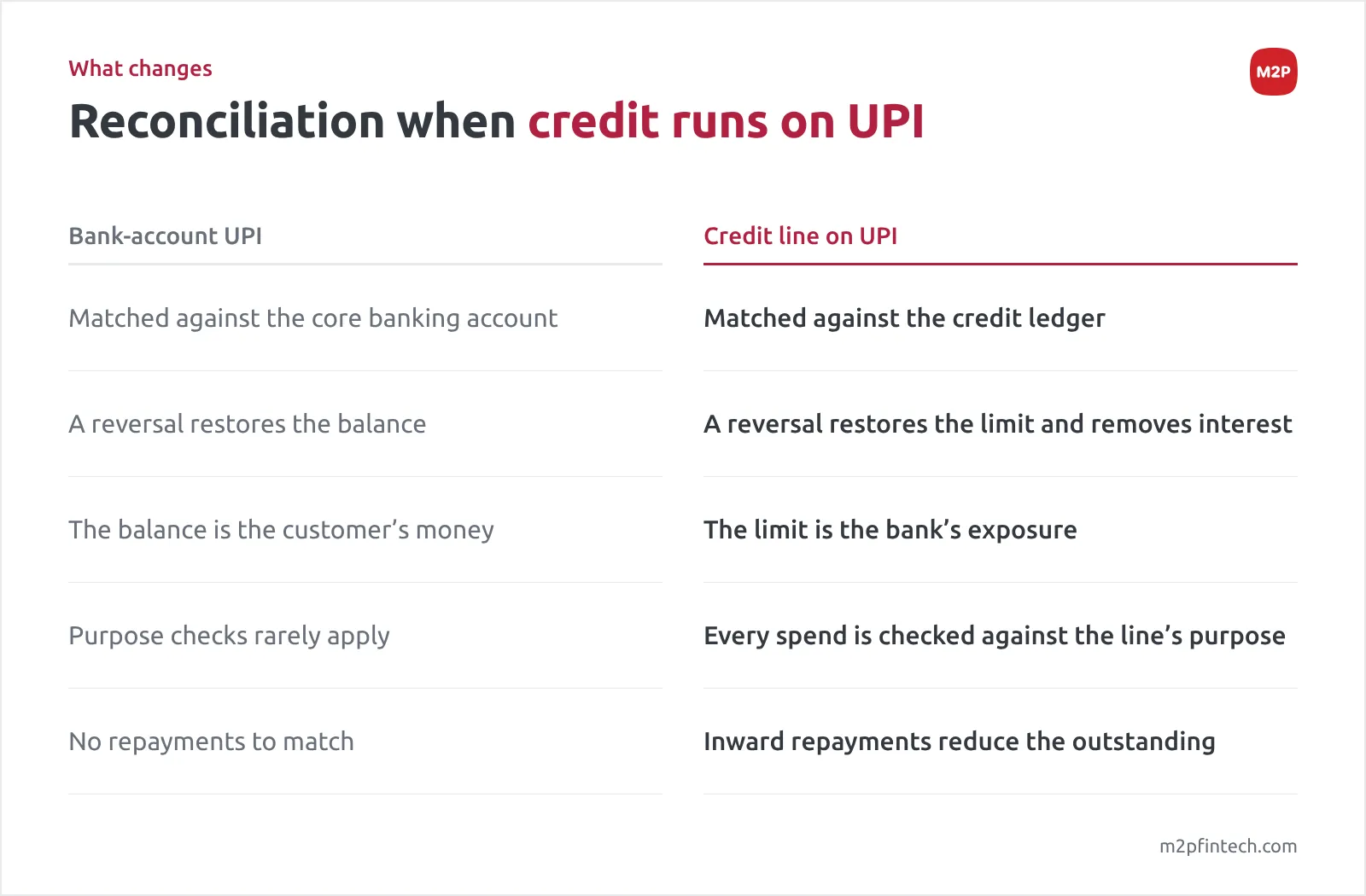
Credit line on UPI reconciliation also has one break that bank accounts do not. On a CLIB line, interest accrues from the transaction date. A reversal must restore the available limit and remove any interest charged on that amount. Make this a separate recon rule, because a reversal that fixes the limit and leaves the interest is the error customers notice first.
Fraud and reconciliation teams often look at the same transactions from different screens. Joining them closes gaps on both sides, and credit line on UPI fraud is easier to spot when breaks and alerts meet.
Treat credit line on UPI reconciliation breaks as fraud signals. Send the fraud team repeated reversals on one merchant, or ledger-only debits on one line. Send fraud decisions back to reconciliation: blocked lines, disputed payments, and chargebacks, so the case file and the ledger tell the same story.
At month-end, close with general ledger reconciliation of the credit portfolio against the settlement account, as you would for any digital reconciliation program.
Use this checklist to test your fraud controls and your credit line on UPI reconciliation setup.
PIN and linking. The PIN-set and linking events are scored, and the customer is told outside the app.
Authorization. Purpose, MCC, P2P eligibility, velocity, device, and mule checks run within the response window.
Utilization. Speed to full draw, repay-and-redraw loops, and failed repayments feed your EWS framework.
First-party fraud. Link analysis, merchant monitoring, and limit-increase holds are live, with cases routed to RFA.
Three-way match. Credit line on UPI reconciliation matches switch, ledger, and settlement daily on transaction ID and the standard account reference.
Exceptions. UDIR timing rules are followed, and reversals restore both limit and interest.
Avoid three common mistakes.
Reusing the savings account recon. Rules built for core banking accounts miss limit and interest breaks in the credit ledger.
Scoring after the credit decision. Sequential checks cause timeouts and pressure to relax rules.
Manual fixes on the transaction date. Same-day manual reversals are the main source of double credits.
M2P Fintech's Credit Line on UPI runs on Core Lending Suite. A revolving credit line management system, a business rule engine, and an NPCI-certified UPI product sit on one platform. Fraud monitoring and automated reconciliation are part of the same stack, so the three data sources in this guide come from connected systems.
M2P's fraud and risk management system, FRM & AML, scores transactions in real time with AI and machine learning (ML) models. It covers cards, wallets, and real-time payments. Risk teams configure their own rules, and every alert moves through case management with a full trail, so analysts stay in control of each decision.
M2P's Recon360 payment reconciliation software handles credit line on UPI reconciliation with rule-based, N-way matching. It adds exception handling, dispute life cycle management, and GL reconciliation. It can reconcile up to 1 billion transactions in 29 minutes, depending on data volume and configuration. Book a demo with M2P to see how the two layers fit together.
NPCI's product page asks users to set a distinct UPI PIN for the credit line and not reuse their savings account PIN. Banks should score PIN setup as a credit line on UPI fraud event.
Under NPCI's September 18, 2026 consolidated circular, interest-bearing credit lines (CLIB) can be used for P2P payments. Interest-free lines (CLIF) are limited to merchant and related use cases.
Each payment touches the UPI switch, the credit ledger, and NPCI settlement. Matching the switch only against settlement or the core banking ledger misses credit ledger breaks. Examples are limits not reduced and interest not reversed.
Banks follow the RBI Master Directions on Fraud Risk Management of July 15, 2024, including the Early Warning Signals and Red Flagging of Accounts framework. This is an overview, not legal advice.


Fintech is evolving every day. That's why you need our newsletter! Get the latest fintech news, views, insights, directly to your inbox every fortnight for FREE!